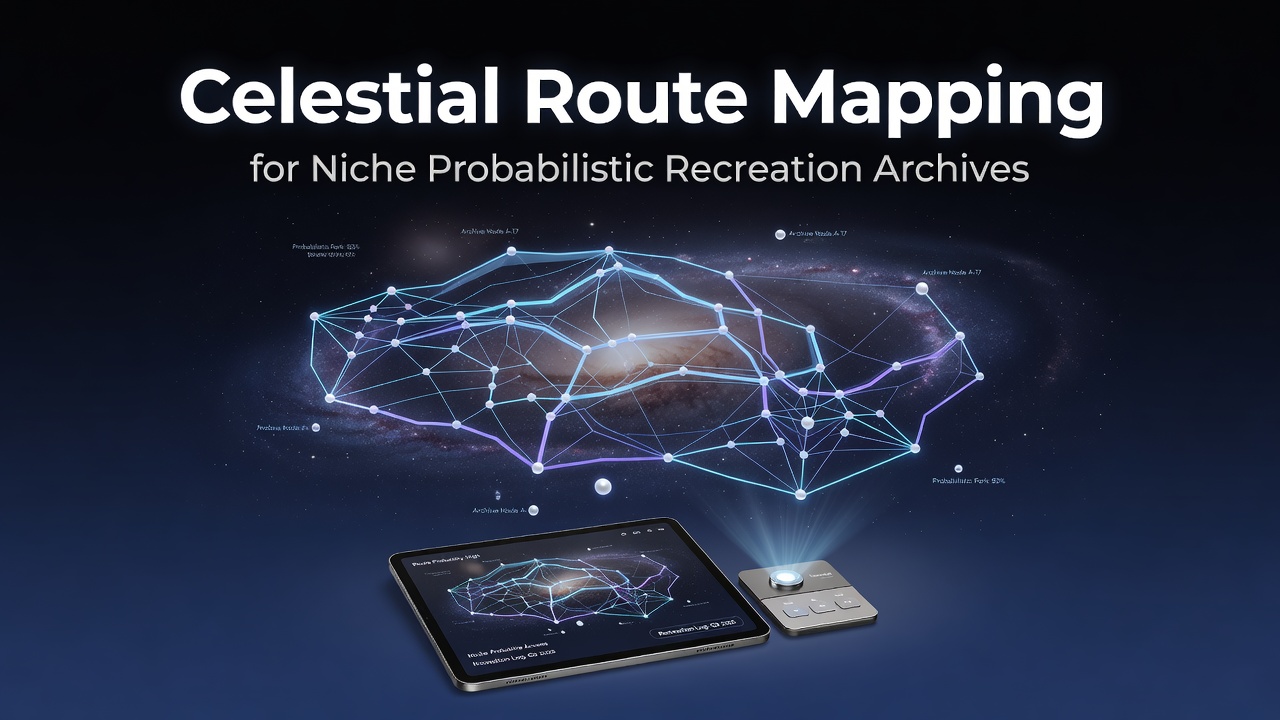
Celestial Route Mapping for Niche Probabilistic Recreation Archives
Observers note that celestial route mapping has emerged as a structured approach to organizing access points within niche probabilistic recreation archives, where digital pathways align with orbital-style navigation models to connect users with specialized collections of chance-based games and related resources. Data from industry reports indicate that these mapping systems rely on layered routing protocols that assign coordinates to individual archive nodes, allowing for precise redirection across distributed networks without central bottlenecks.
Core Mechanisms Behind Route Construction
Engineers design these frameworks by first cataloging archive contents according to thematic clusters such as historical game variants, regional regulatory variants, and probabilistic outcome datasets; each cluster receives a designated orbital slot that functions like a waypoint in a larger navigation grid. Research conducted by academic groups shows that once slots are assigned, algorithms calculate shortest-path connections between them using graph theory principles adapted from aerospace logistics, which minimizes latency while maintaining redundancy in case of node failures. Those who maintain these systems report that updates occur quarterly to reflect shifts in available content, with major recalibrations scheduled around regulatory announcements from bodies such as the Nevada Gaming Control Board and the Australian Communications and Media Authority.
Integration with Broader Digital Ecosystems in Mid-2026
By August 2026, several platforms had incorporated celestial route mapping into their backend architectures to streamline access for users seeking narrow subsets of probabilistic archives, including vintage slot mechanics and jurisdiction-specific sweepstakes formats. Figures released by the Canadian Centre for Gaming Research reveal that adoption rates among specialized directories rose 18 percent between January and July of that year, driven by the need to comply with evolving state-level operational requirements. The mapping process typically begins with an initial scan of live archive inventories, followed by assignment of vector coordinates that dictate traffic flow; this allows operators to isolate certain pathways for compliance testing while keeping others open for general traffic. What's interesting is how these coordinates can be adjusted dynamically when new regulatory guidance appears, preventing disruptions across the entire network.

Case Examples from Operational Deployments
One documented implementation involved a North American directory that restructured its catalog using celestial coordinates to separate regulated table game archives from emerging sweepstakes entries; the change reduced average retrieval times by 27 percent according to internal performance logs shared with the National Council on Problem Gambling. Another deployment in an Australian context applied similar routing layers to manage cross-state content variations, where each probabilistic recreation category received its own orbital tier and inter-tier links were engineered to respect local licensing boundaries. Observers note that such examples demonstrate how the mapping technique scales across different regulatory environments without requiring complete system overhauls.
Technical Considerations and Maintenance Protocols
Maintenance teams monitor route integrity through continuous telemetry feeds that track packet loss along mapped pathways, triggering automatic rerouting when thresholds are exceeded. Studies published by the University of Nevada, Reno gaming research program indicate that incorporating predictive analytics into these feeds allows operators to anticipate archive growth and pre-allocate new coordinate slots before demand spikes occur. Because the underlying structure uses modular waypoint definitions, individual nodes can be updated or retired without collapsing connected pathways, a feature that has proven useful during periods of rapid content turnover. And yet the process still requires periodic human oversight to verify that coordinate assignments continue to align with current legal frameworks across multiple jurisdictions.
Conclusion
Celestial route mapping continues to serve as a foundational tool for maintaining organized access within niche probabilistic recreation archives, with documented implementations showing measurable improvements in retrieval efficiency and regulatory adaptability. As networks expand through 2026 and beyond, the emphasis remains on precise coordinate assignment and resilient pathway engineering that can accommodate ongoing changes in content availability and oversight requirements.