
Sweepstakes Casinos Face State-Level Bans and Operational Shifts in Early 2026
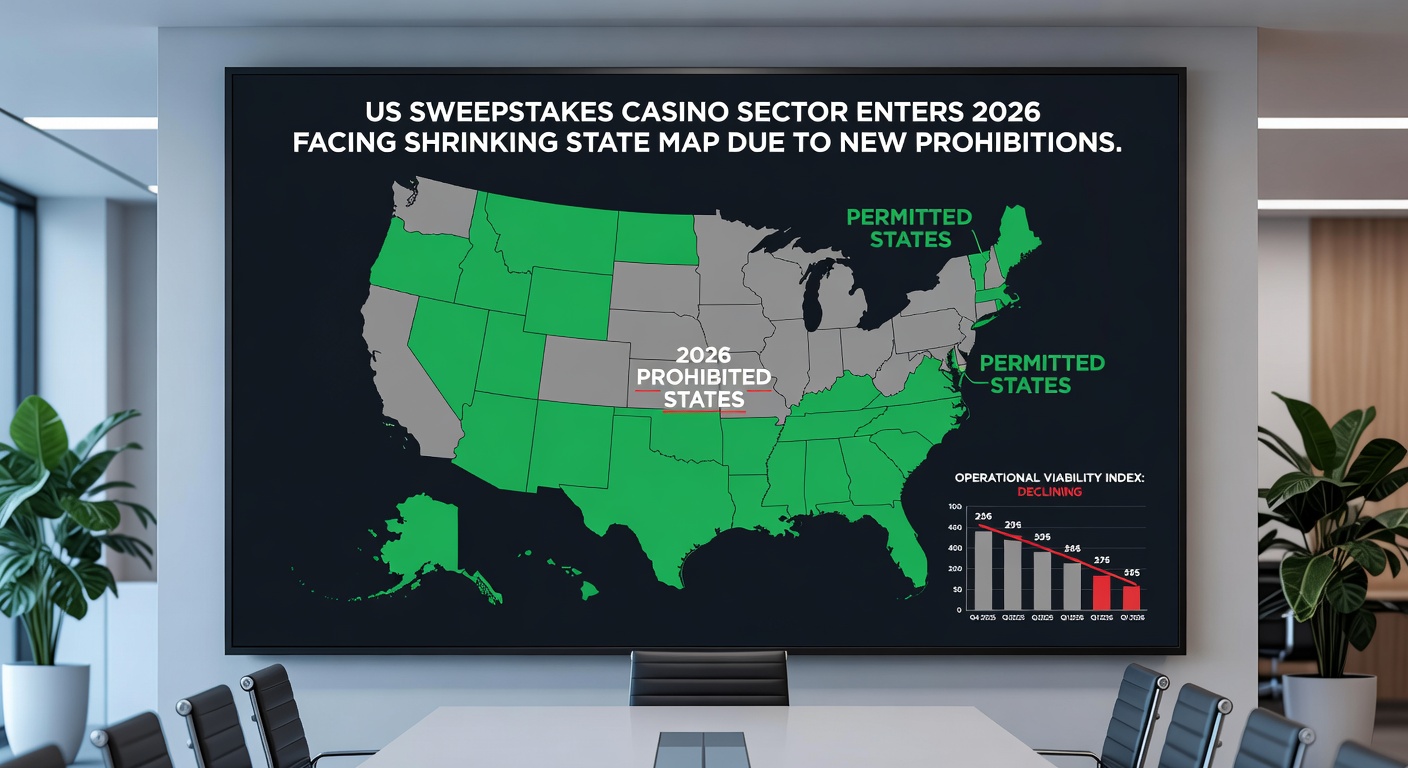
California’s Assembly Bill 831 took effect on January 1, 2026, and removed an estimated one-fifth of national sweepstakes casino revenue from the market while Indiana’s House Bill 1052 moved toward implementation on July 1 of the same year. These measures reduced the number of states where dual-coin sweepstakes platforms could operate without additional legal risk. Operators responded by exiting restricted jurisdictions, adjusting brand portfolios, and exploring new payment methods under continued regulatory and litigation pressure.
California Legislation Removes Significant Revenue Share
Assembly Bill 831 established clearer prohibitions on sweepstakes casino mechanics that had previously allowed gold-coin and sweepstakes-coin systems to function in the state. Revenue estimates compiled before the effective date placed California’s contribution at roughly twenty percent of total national sweepstakes activity. Companies that relied on the dual-coin model therefore faced an immediate contraction in addressable market size. Legal teams at several major platforms began winding down operations in the state during the final weeks of 2025 so that compliance deadlines would not create additional exposure.
Indiana Measure Adds Further Geographic Pressure
House Bill 1052 followed a similar pattern by targeting sweepstakes promotions that combine free and paid elements within the same platform. The July 1, 2026, effective date gave operators a six-month window after the California change to prepare additional exits. Industry tracking conducted in May 2026 showed that several platforms had already begun limiting marketing spend and user acquisition campaigns inside Indiana ahead of the cutoff. The combined effect of the two bills reduced the number of states considered fully viable for traditional dual-coin products.
Operator Responses Include Brand Realignment and New Launches
Virtual Gaming Worlds, the parent company behind Chumba Casino and related sites, initiated state-by-state withdrawals beginning in the first quarter of 2026. At the same time the company introduced Just Slots, a brand built without the dual-coin structure that had triggered regulatory scrutiny. Marketing teams shifted emphasis toward single-currency gameplay and revised creative assets to avoid references that could be interpreted as violating new state rules. Payment rails also received attention as operators sought processors willing to handle transactions in jurisdictions with narrower definitions of permissible sweepstakes activity.
Marketing and Compliance Adjustments Continue Through Mid-2026
By May 2026, remaining platforms had narrowed geographic targeting in paid-search and social campaigns to states still permitting dual-coin operations. Creative testing focused on language that emphasized entertainment value rather than prize mechanics. Data from advertising platforms indicated lower click-through rates in states adjacent to newly restricted markets, suggesting users anticipated further regulatory movement. Companies that maintained multi-state footprints reported allocating additional compliance resources to monitor legislative calendars in states that had not yet acted.
Litigation and Regulatory Scrutiny Shape Future Planning
Multiple operators faced ongoing lawsuits that questioned whether sweepstakes-coin mechanics constituted illegal gambling under existing state statutes. Court filings referenced in industry summaries during the spring of 2026 highlighted disputes over whether users receive sufficient free currency to avoid any element of consideration. Legal departments therefore coordinated with product teams to document user-acquisition flows and currency distribution methods. Some platforms explored partnerships with established payment processors that already maintained compliance programs for heavily regulated verticals, thereby reducing the risk of abrupt service termination.
State Map Continues to Contract
Observers tracking regulatory developments noted that additional states had introduced or advanced similar legislation by the middle of 2026. The pattern established in California and Indiana appeared to encourage other legislatures to examine sweepstakes models that blend free and paid elements. Companies that had diversified into non-dual-coin products positioned those brands for potential expansion into states that had previously remained closed. Revenue forecasts circulated among investors reflected both the immediate loss from the two enacted bills and the possibility of further state-level restrictions before the end of the calendar year.
Conclusion
The sequence of prohibitions that began with California’s January 1, 2026, implementation and continued toward Indiana’s July effective date produced measurable contraction in the sweepstakes casino sector. Operators responded with state exits, new brand development, and revised marketing and payment strategies. As of May 2026 the operating map had already narrowed, and companies continued to monitor legislative activity in additional states while adapting product structures to remain within permitted boundaries.